Sunday, May 20, 2007


#30 - The Red Shoes (1948, Michael Powell / Emeric Pressburger)


This movie was really interesting because it was a musical without any singing! We've got an idealistic dancer, the composer she loves, a tyrannical director, backstage drama, everything you'd expect from the Dream Factory except the tunes. Of course, I generally am apathetic about the tunes so this is cool with me. Except that most of this movie left me wanting more, it's pretty light on actual drama and the like.

But OH MAN, the mid-film ballet sequence!! Only the best fifteen minutes of film EVER!!!! I'm totally a sucker for any supposed stage performance that utilizes crane shots, superimposition and montage. You know, just like the real ballet. I'm not kidding though, this and all those awesome Busby Berkley numbers rule so hard because they do so much that theater can't offer. If only there were more ballet films like this! I wish the whole thing was ballet. I guess I should see The Tales of Hoffmann, that's a full opera in this style. I hope it is.

new #100:

Saturday, May 19, 2007


#57 - The Shop Around the Corner (1940, Ernst Lubitsch)

This was cute. I liked it.

new #100:

Monday, May 07, 2007


#37 - Two or Three Things I Know About Her (1967, Jean-Luc Godard)

I love me some Godard but this was a mess. I really couldn't tell what it was about. Was it the story of a young suburban housewife working part-time as a prostitute? An experiment about what people really are thinking during day-to-day small talk? An indictment of consumerism? Something to do with Vietnam? There were a lot of big ideas, all just glossed over with no unifying theme. Cinematography was outstanding, however. Still, I dunno... this seems to be the moment Godard loses me. Weekend is an absolute masterpiece though. I still need to see La Chinoise.

new #100: Terra em Transe

Tuesday, May 01, 2007


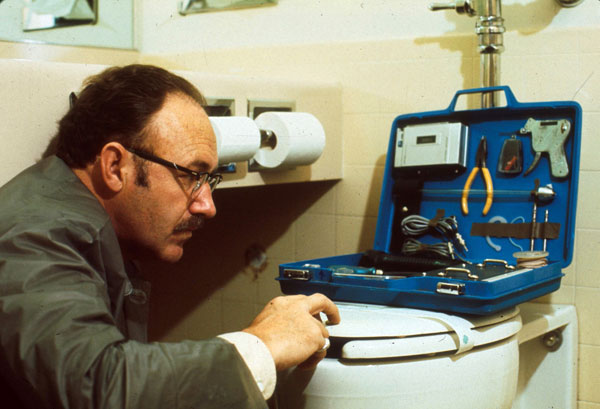
#46 - The Conversation (1974, Francis Ford Coppola)


Wow, it's been a long time since I've updated. I actually watched this about a week ago but I've been way busy with essays and visiting my sister in Pittsburgh. This movie is excellent, by the way. I'm sure I'm the last person on Earth to see it, but yeah. Gene Hackman is incredible. It was a thrill watching his conscience take over as he found himself unable to separate himself from his work any longer. I also found it interesting that we never really discovered the importance of the conversation in the park, or rather, we found out that it wasn't what they were saying, but that they were saying anything at all. Great cinematography too, especially the shots that looked like Blue Note jazz covers.

new #100: Aliens

Monday, April 16, 2007


#63 - Throne of Blood (1957, Akira Kurosawa)


I saw this at the AFI the same night as Sansho the Bailiff, this one being part of the "Shakespeare in Washington" festival. This is of course, Kurosawa's adaptation of Macbeth, set in feudal Japan. While mostly faithful to Shakespeare's original, Throne of Blood goes Macduff-less and features a ghost of an old man rather than the witches.

Kurosawa's foggy forest settings complement the ghost story, which evidently is inspired by Noh theater. Stephen Prince argues that the film is Kurosawa's attempt to portray Shakespeare in the kind of Japanese theater popular in Shakespeare's day. I dug it, but there's Kurosawas I like more.

new #100: Black God, White Devil

Sunday, April 15, 2007


#13 - Sansho the Bailiff (1954, Kenji Mizoguchi)

More goodies from the Mizo retro at the AFI. Although a DVD is (finally!) arriving next month, I absolutely had to see this on the big screen. Unfortunately, this meant seeing in on 4 hours of sleep with no time to make a run to the concession stand beforehand to load up on caffeine. Just barely getting in on time (the "Directed by Kenji Mizoguchi" credit was onscreen when I took my seat) meant I had to sit in the very front of the theater (good showing by the way, kudos DC-area cinema patrons) with my head tilted all the way up, in the position one assumes when trying to sleep in a car, or a cinema.

Yup, I missed a great deal of the final act. I saw the final reunion with Zushio and his mother but I did not see him discover the fates of his father and sister. Fuck spoiler tags, yo. Thank God I'll be able to watch this again on DVD in a month to tie up loose ends.

Of course, what I saw (and what I saw was at least 3/4 of the two-hour movie) was phenomenal. Mizoguchi is definitely one of my favorite filmmakers of all time. I love how his postwar films deftly address contemporary social issues in a jidai-geki setting. Both Sansho and Ugetsu deal with the horrors of war and fascism and Oharu showed how women are still degraded and mistreated. It'll be interesting to see Street of Shame later this week (oh, I hope I don't have to work) to see how Mizo crafts a contemporary film. Too bad A Geisha isn't being shown, that's one I want to see soon too. Ah well, we have the Masters of Cinema Mizoguchi box and a Criterion Eclipse box coming soon so 2007 looks to finally be the year Kenji Mizoguchi gets his due on DVD.

new #100: The Terminator (honest, I've only seen T2!)

Saturday, April 14, 2007


#41 - Paths of Glory (1957. Stanley Kubrick)

If not the greatest anti-war film ever, could this be at least the most cynical and at the same time heartbreaking indictment of the war politic? Of course, talking about the scenes that affected be would be spoiler city, so I guess no mention of that. Though I've always liked Kubrick, I never disagreed with complaints that his films are mechanical or lacking emotion until I saw Paths of Glory. It's so awful and so timely too.

new #100: All Quiet on the Western Front (what a coincidence!)

Thursday, April 12, 2007


#69 - The Life of Oharu (1952, Kenji Mizoguchi)

The AFI Silver is doing a Mizoguchi session at the moment so I was thankful I got the chance to see this movie, frustratingly not available on R1 DVD. This movie, wow. Set in 17th century Japan but completely timeless, Oharu chronicles the decline and degradation of a young woman, once a courtesan to a mighty lord, now a 50 year old street whore.

Kinuyo Tanaka gives a knockout performance as the title character, saying little but saying so much. I always find it hardest to write about the films on this list that hit me hardest.

new #100: Senso

Monday, April 09, 2007


#41 - The World of Apu (1959, Satyajit Ray)

After the domestic box-office failure of 1957's Parash Pather and 1958's Jalsaghar, Satyajit Ray found himself returning to the hero of his first two films to make good on a promise to deliver a trilogy of films based on Bibhutibhushan Bandyopadhyay's Apu character.

The World of Apu picks up where Aparajito left off (the novel Aparajito was split into the two films). Apu, now a young man in Calcutta, has *most* of a college degree and is *kind of* looking for work. Basically, he has become his father, but in a modern, urban environment.

A friend invites him to his cousin's wedding and in a wacky turn of events, Apu finds himself the groom! He now must take responsibility for not only his life, but his young bride's as well. And then, tragedy strikes. Again.

This could very well be my favorite Ray even if the scenario is a bit sitcom-y and later, soap operatic. Subrata Mitra's cinematography continues to evolve and I must confess to relating pretty strongly to Apu in this film. And you've gotta love that ending.

new #100: High and Low

Sunday, April 08, 2007


#10 - On the Waterfront (1954, Elia Kazan)

I can't believe I'd put this one off until now. I guess it's rare when the Academy and the AFI get it right, but this is truly a landmark American picture. Brando is as fantastic as ever, as is the rest of the cast. The realism is of a level rarely seen in studio-era Hollywood. I'm consistently reminded of the second season of The Wire, which shares the same characters and location as well as journalistic research into the subject. Truly moving and accomplished picture.

new #100: Sans Soleil

Thursday, April 05, 2007


#40 - Close-Up (1990, Abbas Kiarostami)

One of the benchmarks of the Iranian New Wave, Kiarostami's most acclaimed feature is an unusual mix of documentary and fiction that seems to exist in no other national cinema. In this film, we are shown the true story of a man who convinced a family he was director Mohsen Makhmalbaf and his subsequent trial. From what I understand, all the actors in the film were the actual people in the case. I haven't seen a lot of Iranian films, just a few others of Kiarostami's, but many use this technique.

I kind of thought the court scenes dragged a bit, also I would have preferred more stylization in the visual images. But the final scenes in which Mr. Sabzian, the imposter, meets the real Mohsen Makhmalbaf was very impressive. Seeing real events happen before our eyes- not documentary really, but completely unscripted. Kiarostami even breaks the fourth wall setting up the scene.

I can't recommend the Facets DVD at all however. They have a much-deserved reputation as the absolute worst DVD company specializing in foreign arthouse cinema and this was one of their worse efforts. The sound is atrocious, in bad need of de-essing (sp?), the colors ugly and the forced subtitles in blocks. It looked like what Borat was parodying. But good film either way. Hope Criterion or someone can get the rights to this.

new #100: To Have and Have Not

Sunday, April 01, 2007

LIST UPDATE


Here's how this project looks as of April 1, 2007. Numbers in parentheses represent the overall ranking on TSPDT's top 1000 master list.

1. Children of Paradise (24)
2. The Gold Rush (37)
3. Intolerance (44)
4. The Wild Bunch (55)
5. La Strada (59)
6. Fanny and Alexander (62)
7. Greed (64)
8. The Earrings of Madame de... (68)
9. Voyage in Italy (75)
10. On the Waterfront (80)
11. Pierrot Le Fou (81)
12. The Leopard (85)
13. Gone with the Wind (88)
14. Sansho the Bailiff (89)
15. Last Year at Marienbad (91)
16. The Decalogue (94)
17. Letter from an Unknown Woman (95)
18. Gertrud (101)
19. The Treasure of the Sierra Madre (102)
20. Earth (110)
21. Napoleon (116)
22. Shoah (117)
23. Ashes and Diamonds (121)
24. Black Narcissus (123)
25. Broken Blossoms (126)
26. Red River (127)
27. Ivan the Terrible (128)
28. The Grapes of Wrath (134)
29. Brief Encounter (137)
30. The Gospel According to St. Matthew (138)
31. The Exterminating Angel (139)
32. The Red Shoes (140)
33. Paisan (141)
34. The Sweet Smell of Success (142)
35. Rome, Open City (143)
36. Jeanne Dielman, 23 Quai de Commerce, 1080 Bruxelles (145)
37. Kind Hearts and Coronets (146)
38. La Notte (153)
39. Two or Three Things I Know About Her (154)
40. Close-Up (157)
41. The Maltese Falcon (158)
42. One Flew Over the Cuckoo's Nest (160)
43. The World of Apu (164)
44. Paths of Glory (166)
45. Once Upon a Time in America (167)
46. The Philadelphia Story (168)
47. Meet Me in St. Louis (170)
48. Monsieur Verdoux (172)
49. The Good, the Bad & the Ugly (173)
50. The Traveling Players (179)
51. The Conversation (180)
52. A Matter of Life and Death (181)
53. The Crowd (185)
54. Vampyr (186)
55. Alexander Nevsky (190)
56. The Wages of Fear (191)
57. The Life & Death of Colonel Blimp (192)
58. The Exorcist (194)
59. A Star is Born (195)
60. Schindler's List (202)
61. Crimes and Misdemeanors (203)
62. Rocco and His Brothers (204)
63. The Crime of Monsieur Lange (205)
64. The Shop Around the Corner (208)
65. The Band Wagon (210)
66. A Day in the Country (216)
67. Written on the Wind (217)
68. Throne of Blood (219)
69. Berlin Alexanderplatz (220)
70. Germany, Year Zero (224)
71. Death in Venice (226)
72. The Life of Oharu (228)
73. Unforgiven (230)
74. The Tree of Wooden Clogs (232)
75. Les Vampires (233)
76. The Navigator (234)
77. The Awful Truth (236)
78. Strike (240)
79. Ninotchka (243)
80. Salo (248)
81. The Passenger (250)
82. Kings of the Road (251)
83. The Time to Live and the Time to Die (254)
84. Floating Clouds (256)
85. The Deer Hunter (257)
86. 1900 (258)
87. Marnie (260)
88. Only Angels Have Wings (262)
89. The Quiet Man (263)
90. Lola Montes (265)
91. The Young Girls of Rochefort (266)
92. Salvatore Giuliano (267)
93. Limelight (269)
94. Great Expectations (274)
95. October (278)
96. A City of Sadness (279)
97. The Great Dictator (280)
98. Tristana (288)
99. The Kid (291)
100. Deliverance (293)


#66 - Wings of Desire (1987, Wim Wenders)

Some of the most amazing camerawork I've ever seen on this film. Somebody put in overtime on the helicopter cam on this one. Sweeping through Berlin in glorious sepia-tone, Wings of Desire is a glorious visual feast.

But oh man, this movie is corny! Now I'm not the type to disparage a film over Christian/spiritual themes - I LOVE all those boring, spiritual crisis films by Bresson, Dreyer, Tarkovsky, Bergman. I think I just kind of draw the line at angels. Sorry, just can't take them seriously. We're moving into QVC collectible-plate territory here. I dunno, I could very easily see myself grow to love this film but for now, nah.

new #100: Deliverance

Saturday, March 31, 2007


#96 - Aparajito (1956, Satyajit Ray)

The second in Ray's Apu trilogy picks up where Pather Panchali left off, with Apu's family picking up and moving from their rural village to the city of Benares along the Ganghes River. Tragedy strikes the Roys again and Apu, now a teenager, gets a scholarship to college in Calcutta, where he gradually grows distant from his mother.

Aparajito is a bit more narratively focused than Pather Panchali, but I liked the debut's wide-eyed wonderment more than the more mature Aparajito, which kind of felt like a lot of coming-of-age films I've already seen (granted, most of which were probably copping Ray's steez). I am excited to see what The World of Apu has in store for me. Tune in next week!

new #100: The Kid

Thursday, March 29, 2007


#24 - Umberto D. (1952, Vittorio de Sica)

After watching Ray's rural South Asian take on neorealism, I thought I'd view one of de Sica's Italian classics. Umberto D. is the story of an old man who has nothing - money, health, family - except his lovable pooch, Flike. We watch Umberto struggle to raise enough money to pay off his debt to his landlady and keep his apartment.

I'm constantly reminded of Akira Kurosawa's Ikiru from the same year. Both directors utilize a symphony of tiny violins to tug at our heartstrings but Kurosawa's hero is trying to achieve something grand, while Umberto is just trying to survive. Ikiru is a movie I admire, but it gets pretty sappy at times. Umberto D. doesn't quite go quite as all out in the melodrama but I dunno, I like melodrama anyway. So, eh, good movie but not great.

new #100: Tristana

Wednesday, March 28, 2007


#3 - Pather Panchali (1955, Satyajit Ray)

Charulata and Jalsaghar whet my appetite for this, the main course in Satyajit Ray's filmography, the Apu trilogy. Pather Panchali is the first, and Ray's first film overall. This may be one of the most accomplished debuts in all of film and certainly one that elevated an entire national cinema.

Ray was inspired by Vittorio de Sica and the other Italian neorealists. One senses that influence in the realistic portrayals of poverty and the use of non-actors, but Ray adds a calm, contemplative pace reminiscent of contemporaneous Japanese cinema, which suits the serene forest atmosphere well.

new #100: The Great Dictator

Wednesday, March 21, 2007


#10 - Sherlock Jr. (1924, Buster Keaton)

Watched this on the Kino double-bill with Our Hospitality, which seemed like a dry run at The General, but Sherlock Jr. blew me away. Best Keaton film I've seen yet and infinitely better than any Chaplin (I rewatched Modern Times last night and it didn't hold up to Buster). Amazing how much humor and imagination can fit into just 45 minutes of screen time.

I'm not sure if this is the first reflexive film-as-dream film ever made, but it seems to anticipate such supreme Mike Ouderkirk favorites as The Wizard of Oz and Mulholland Dr. in structure. Plus the slapstick is just plain funny like when the men try to murder his dream self. Buster keaton was quite the pool player! The obligatory train sequence was an amazing physical performance by Buster or his stunt double. A+++ will watch again and again and again.

new #100: A City of Sadness

Tuesday, March 20, 2007


#51 - The Music Room (1958, Satyajit Ray)

Nobody watches Satyajit Ray movies anymore. Only the Apu trilogy has been released on DVD in America and those are out of print (supposedly really bad quality too... we'll see, I just rented Pather Panchali today). No news about anything on the horizon, nor any touring retrospectives so I guess we're just stuck with VHS for now.

The Music Room I actually saw on a bootleg DVD that my local library stocked for some reason. It was VHS-quality but with badly-synched subtitles that were always at least one line off. Honestly, I'd have been better off watching a VHS with burnt-in subs. Anywho, thankfully it's not a film I needed subtitles to enjoy as much of the appeal is through the performances of Indian classical music and the magnificent cinematography, reminiscent of Kenji Mizoguchi.

The Music Room is about a feudal lord whose land has eroded from a flood and with it left his wealth and prestige. The new generation is taking over, more westernized, but Roy will have none of it. He basks in past glories and then throws the grandest performance his friends have ever seen with the last rupees he has left. A wonderful film that I would love to see in a decent print with decent subtitles. Dammit Criterion, get your ass in gear!

new #100: October

Monday, March 19, 2007


#9 - Rio Bravo (1959, Howard Hawks)

Anyone who follows this blog (which may well be nobody) knows I've been learning to love westerns over the past few months. So yet again, it's another week, another new favorite western. Hawks and Wayne intended this to be a response to High Noon, which they felt was a poor representation of the spirit of a true western sheriff. What could be a reactionary dirge (see: any Duke movie after this), is a fun, character-driven romp. What I love about Rio Bravo is the looseness to the proceedings. There is next to no plot, just a bunch of guys hanging around drinking and smoking and trying not to drink and smoke.

As Sheriff John T. Chance, John Wayne is the straight man amongst a rag-tag gang protecting the town, always responsible and sensible though he can take a joke. Dean Martin is the other lead, a sheriff's deputy struggling with sobriety after a two-year bender. Ricky Nelson is way out of his league as the scrappy young gunslinger taken under Chance's wing. He finally makes himself useful in a totally unnecessary but totally entertaining pair of musical numbers with Martin.

new #100: Aparajito

Wednesday, March 14, 2007


#55 - Performance (1970, Donald Cammell & Nicolas Roeg)

The greatest film to come out of the 1960s counterculture, Performance blew me away like few films ever have. A look into the myriad ways of presenting masculinity and male sexuality, Performance starts out as a blistering gangster film only to morph into an extended mushroom trip after macho Chas hides out in Mick Jagger's house, trying to fit in with the weirdo hipsters it houses.

Jagger plays Turner, a reclusive retired rock star who lives in a delapitated mansion in a menage-a-trois with Anita Pallenberg and a little French runaway. The shots of his house are breathtaking, such a seemingly modest-sized home has an endless supply of rooms and corridors to hide in. Nicolas Roeg films always look amazing and this is the best-looking of them all.

This film has been running through my head all day and unfortunately nothing is coming out onto the ol' blog. But trust me, this is top 10 all-time for me.

new #100: Great Expectations